Eighty-Five Seconds
And What we Should Do

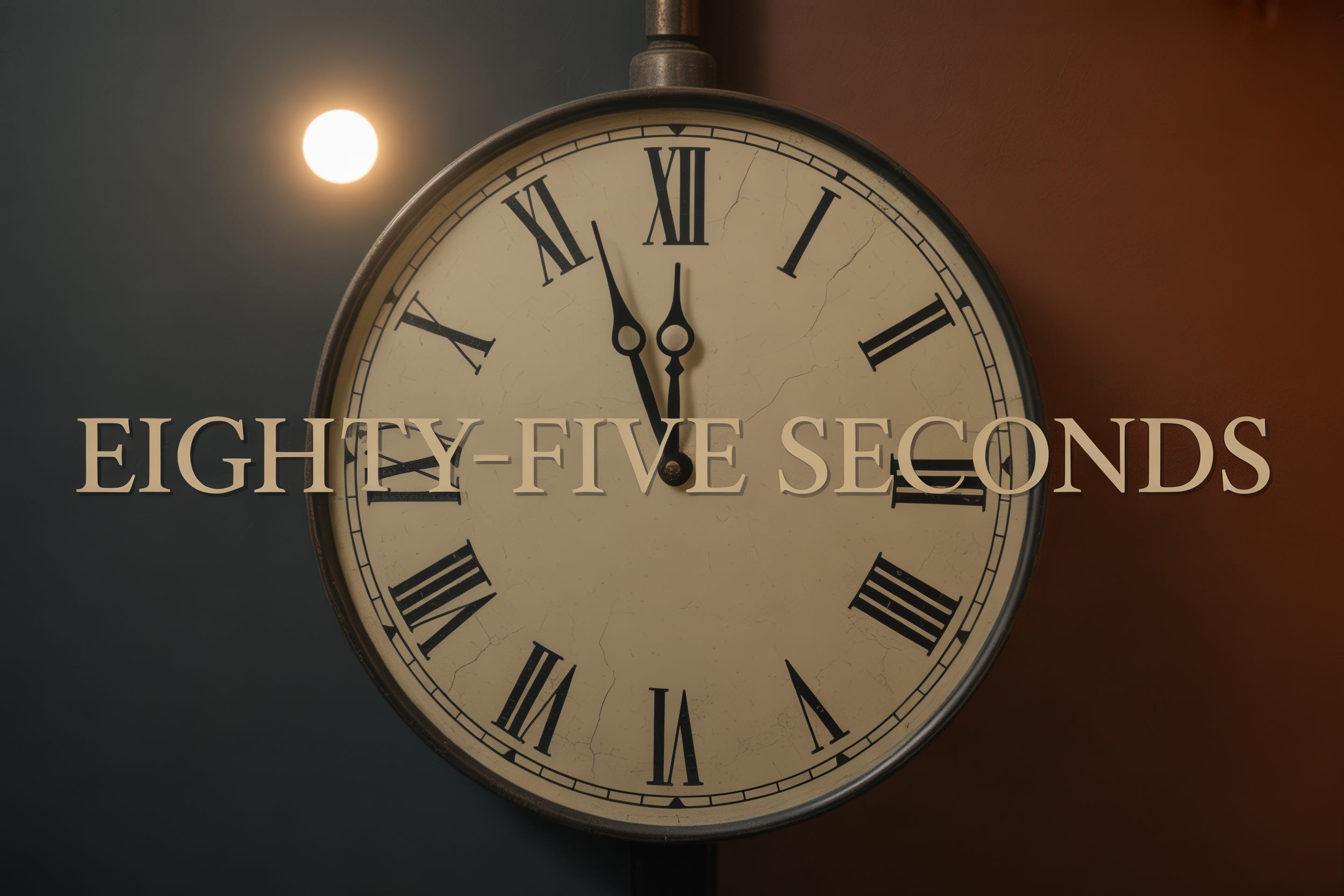
Eighty-Five Seconds
Notes on a Clock That Measures What Cannot Be Measured
There is a difference between a number that measures something and a number that means something. The Doomsday Clock, which since January of 2026 has stood at eighty-five seconds before midnight, is the second kind of number. Nothing is being counted. No mechanism advances toward an event. The hand moves when a small group of people, looking at the world, decides it should move. The number is a judgment dressed as a measurement.
This is sometimes given as the reason the clock should be ignored. I want to argue the opposite. The clock is worth taking seriously precisely because it is a judgment dressed as a measurement, and because the dressing is doing work the judgment alone could not do.
Four questions are worth asking about the eighty-five seconds. Why is the number where it is? Is the judgment behind it a real consensus, or the assertion of one small board? Even if it is consensus, is it valid? And finally, does any of it tell us what is likely to happen, or whether the likely thing can be averted?
I will take these in order, and then I will say what I think the clock actually asks of the people who notice it.
The Clock, Plainly Described
The Doomsday Clock was invented in 1947 by the Bulletin of the Atomic Scientists, a group of physicists many of whom had worked on the Manhattan Project. The first hand was set at seven minutes to midnight. Midnight was understood, then, to be a specific event: nuclear war between the United States and the Soviet Union, ending in extinction or near-extinction.
Over the next seventy-nine years the clock moved twenty-seven times, both forward and back. It reached its furthest point from midnight, seventeen minutes, in 1991, after the signing of the Strategic Arms Reduction Treaty. It has been moving steadily back toward midnight since the early 2010s. As of January 2026 it stands at eighty-five seconds, the closest it has ever been since its creation.
What midnight means has also changed. The original clock measured nuclear risk only. In 2007 the Bulletin began incorporating climate change. In recent years it has added biological threats, including pandemic preparedness, and the trajectory of artificial intelligence. The current setting reflects all four.
The mechanism for setting the time is a small board of subject-matter experts, the Science and Security Board, advised by a Board of Sponsors that includes eight Nobel laureates. They meet twice a year. They consult widely. The decision is theirs.
That is the literal description. It is a small group of well-informed people publishing, once a year, their best judgment of how close human civilization stands to self-destruction by its own technology, expressed as a position on a clock face.
This is worth saying clearly because the alternatives, mostly held by people who object to the clock, treat it as either more or less than this. It is not a calibrated instrument. It is also not arbitrary theatre. It is a structured judgment that has been issued, with reasoning, every year for seventy-nine years.
Why It Is Where It Is
The Bulletin’s January 2026 statement names four reasons for the four-second move from eighty-nine to eighty-five.
The first is nuclear. The New START treaty, the last remaining strategic arms-control agreement between the United States and Russia, expires in February of 2026 with no successor in negotiation. All three major nuclear powers, the United States, Russia, and China, are modernizing and expanding their arsenals. The taboo against using nuclear weapons, which held through three quarters of the Cold War, is being publicly questioned by senior officials in multiple capitals. Tactical-nuclear-use scenarios are being discussed inside major militaries with a casualness that has no equivalent in the past decade.
The second is climate. 2024 and 2025 set successive global average temperature records. The 1.5-degree threshold, set in the Paris Agreement as a target ceiling, was crossed on annual average in 2024. Major climate tipping points, the Atlantic Meridional Overturning Circulation, the West Antarctic Ice Sheet, the Amazon, are showing signs of approaching critical thresholds. The political response has slowed even as the physical signal has accelerated.
The third is biological. The institutions built to coordinate global pandemic response after COVID-19 have been weakened or defunded. The World Health Organization has lost its largest contributor. National-level preparedness has degraded. At the same time, the technology required to engineer pathogens has become both cheaper and more accessible. The gap between the difficulty of an attack and the difficulty of a defense has widened.
The fourth is artificial intelligence. The capability of frontier models has grown faster than any forecast. The frameworks for governing them have not. Major laboratories operate under voluntary commitments that have weakened over the past two years. Military integration of AI systems is proceeding without international agreement on what would constitute acceptable use, and the leading military powers have shown no willingness to negotiate one.
Behind all four sits the same observation, which the Bulletin states in its summary as a failure of leadership. The institutions that would address these threats either no longer exist, or have been deliberately weakened, or are being treated as obstacles rather than instruments by the most powerful national governments. The us-versus-them frame has displaced the cooperation frame across multiple domains at once.
This is not an exotic claim. It is the consensus position of essentially every multilateral organization that monitors global risk: the United Nations, the IPCC, the major arms-control NGOs, the global-health bodies, the AI-safety research community. The Bulletin is condensing this into a single number. The number is theirs. The underlying picture is not.
Is It a Real Consensus?
This is the question on which the most useful disagreements turn. The answer depends on whose consensus is being asked about.
Among the relevant expert communities, there is broad consensus that current nuclear, climate, biological, and AI risks have all increased substantially over the past five years. There is consensus that the institutional capacity to address them has decreased. There is consensus that the trajectory is the wrong one. The Bulletin is not an outlier. It is the public-facing condensation of a position held, with variation in emphasis, across most of the relevant fields.
Among the general public in democratic societies, there is no such consensus. Surveys consistently show that most people in the wealthier countries believe their personal future is at risk in moderate ways, but do not believe civilization itself is at meaningful risk over the timescales the Bulletin is talking about. The gap between expert assessment and public assessment, on every one of the four threats, is large and has been widening.
This gap is itself a piece of data. It is also the most important piece of data, in a way the Bulletin’s own framing tends to obscure.
Here is what the gap suggests. Either the experts are wrong (the public’s assessment is the accurate one and the alarms are inflated), or the experts are right but their warnings are not propagating into the cognitive systems of the people they are warning. Both options are uncomfortable. Both deserve to be taken seriously.
I want to argue the second is more likely, and that the reason it is more likely points to something the clock cannot fix.
The Trickster Problem
I have argued elsewhere, in UFOs and the Extra-Consciousness Hypothesis (Cann 2026, Chapter 7), that consciousness as such has a structural blind spot. Consciousness functions by holding strain against the possibility of resolution. It must distinguish what is unresolved from what is resolved, and the felt difference between these two states is what we call experience. This means consciousness is inherently partial. It shows the user the curl, not the ocean. It cannot do otherwise. To show the ocean would dissolve the curl, and conscious experience itself would cease.
I call this the Trickster Proof. Its consequences for the present question are direct.
A civilizational risk that develops over decades, has no single visible trigger, and is composed of slow trajectories in multiple domains is exactly what consciousness is structurally unequipped to perceive. The conscious system is calibrated for immediate threats. A predator. A fire. A fall. It is not calibrated for slow upward drift in atmospheric carbon dioxide, or for the gradual erosion of an arms-control regime, or for the cumulative capability of a class of computational systems no individual experiences as dangerous in any given encounter.
This is not a moral failure of the public. It is a structural feature of what it means to be a conscious being inside time. The Bulletin’s experts are not better-perceiving versions of ordinary people. They are people whose professional role has trained them to attend to slow signals as if they were fast ones, by treating numerical indicators and historical analogies as if they were sensory data. That training is rare and effortful, and it does not generalize.
The clock is a tool for translating slow structural risk into something that can be felt as immediate. Eighty-five seconds is a vivid claim. It enters the mind with the weight of a deadline. The Bulletin has taken something the conscious system cannot perceive natively and given it a sensory shape.
This is, I think, the strongest defense of the clock as a device. It does not measure something the public can verify. It translates something the public cannot perceive at all into a form that the public can at least hold in mind for a few minutes once a year.
It is also the strongest critique. A felt deadline that does not lead to action erodes the felt-deadline system. The Bulletin has been moving the clock toward midnight steadily for over a decade. If midnight does not arrive, and the clock keeps moving, the symbolic vocabulary collapses. The instrument is being asked to do more work than its design allows.
Both are true.
Is the Judgment Largely Valid?
This is the question I find hardest to answer, and the question on which I want to be most careful.
Strip the clock away and ask the underlying question. Are we, in the year 2026, closer to civilizational catastrophe than at any prior point in the post-war period?
On nuclear risk specifically, no. The 1962 Cuban Missile Crisis was a closer brush with extinction than anything currently visible. The 1983 Able Archer incident came nearer to accidental nuclear war than any moment of the present decade has. On the single dimension of nuclear war, the present is dangerous, but it is not unprecedentedly so.
On climate, yes. Every climate metric is at or near a record. The trajectory is unambiguous. The institutional response is degrading. There is no historical analogue.
On biological risk, yes. The combination of degraded institutions and increased technical accessibility produces a risk profile that has no precedent.
On artificial intelligence, the question is malformed. There is no historical baseline. The risk is real and unbounded. The probability distribution is wider than any of the others.
On the combination, which is what the clock attempts to capture, the answer is probably yes. The convergence itself is the new feature. Each individual risk, taken alone, has historical company. The simultaneous degradation of the institutions that address all four is the structurally novel condition.
So the judgment behind the eighty-five seconds is largely valid in its underlying claim, even where the symbolic precision of the number is not defensible. The clock is right about the direction. It is right about the convergence. It is making a defensible judgment about the magnitude. The only thing it is doing that strains credibility is the implication that the magnitude can be expressed as a position on a clock face.
I think we should accept the underlying judgment and treat the position on the face as what it is, a rhetorical handle for a real claim.
What Is Likely To Happen
Three trajectories are worth distinguishing.
The first is drift. The current configuration continues. No single event tips civilization into collapse. Climate damage accumulates. Nuclear arsenals grow. Biotechnology becomes more accessible. AI capability increases without coordination. Institutions remain weakened. Each year more people are harmed by each of the four risks, and the harm is severe enough to be visible without being severe enough to force restructuring. This is the most likely scenario over a five-to-ten-year horizon, and it is what the eighty-five seconds is most plausibly describing.
The second is partial catastrophe. One of the four threats produces an event large enough to reorganize politics. A regional nuclear exchange. A climate cascade in a single domain, say a Western Antarctic ice-shelf collapse, triggering one to two meters of sea-level rise. An engineered pandemic with a mortality rate substantially higher than COVID-19. An AI-driven event whose nature cannot yet be specified. Any of these, individually, has a non-trivial probability inside a ten-year horizon. Collectively, the probability that at least one occurs is higher than most members of the public seem to assume. The aftermath would not be civilizational collapse. It would be the forced, late, expensive reconstruction of the institutional capacity that should have been preserved.
The third is midnight itself. A full nuclear exchange, or a runaway climate cascade, or a pandemic with civilization-ending mortality, or an AI failure with comparable consequences. The probability of each is small in any given year. The probability over a multi-decade horizon, given current trajectories, is no longer negligible.
The clock is best read as a claim that the probability of trajectory three has risen, the probability of trajectory two is now substantial, and trajectory one is the floor rather than the expected case.
This is a sober claim. It is not, by itself, a claim that anyone reading this paper will witness midnight. Most of us will live and die inside trajectory one. What the clock is saying is that we are also living inside conditions that have raised the floor on what trajectory one looks like, and have raised the ceiling on what could replace it.
Can It Be Avoided
The mechanical answer is yes. Each of the four threats has a known mitigation pathway.
For nuclear, an arms-control regime that includes all three major powers, a verifiable ceiling on warhead numbers, restoration of crisis-communication channels, and explicit no-first-use postures from at least the United States and China would substantially reduce the risk. None of these requires technical innovation. They require political agreement.
For climate, the technical pathway to net zero by mid-century exists, is becoming cheaper, and is being deployed at scale in some regions. The remaining barrier is political and institutional, not technical. The trajectory could be bent.
For biological risk, restored funding for the WHO, restored national preparedness, and a multilateral framework on dual-use biotechnology research would substantially close the gap.
For AI, an international agreement on military use, mandatory pre-deployment safety evaluations for frontier systems, and a shared incident-reporting framework would materially reduce risk. Drafts of all three exist. None has been adopted.
The mechanical answer is yes. The institutional answer is also yes. The political answer, today, is no. Or more precisely: the political will to do any of these things exists in pockets, but not in any of the three or four governments whose participation would be necessary.
This is the gap the Bulletin’s failure-of-leadership phrase is pointing at. It is not that we do not know what to do. It is that the people positioned to do it are not doing it, and there is no current mechanism by which the people who are not positioned to do it can compel them.
The honest answer to the question “can it be avoided” is therefore: yes, but not by any process currently underway, and the processes that might begin to do it are themselves subject to the same risks they would address.
The Spectrum
The clock implies a binary. Eighty-five seconds, or some smaller number, or zero. Survival or midnight.
The actual condition is a spectrum, and the spectrum reading is more useful in nearly every case.
A consciousness running with light strain and an open channel can perceive structural risk. A consciousness running with heavy strain and a narrow channel cannot. A society running with high cooperation and functioning institutions can address slow threats. A society running with low cooperation and degraded institutions cannot. None of this is on or off. All of it is dial.
We are not at midnight. We are also not where we were in 1991. We are somewhere on an axis along which we have been moving in the wrong direction for between fifteen and twenty years, and which we have moved along in the right direction at other historical moments.
The right question is not whether we are going to die. It is where on the axis we are, today, and which direction the next move goes.
The clock is one attempt to answer the first part of that question. The second part, which direction the next move goes, is not predetermined. It is the result of choices made by people, including the people reading this paper, between now and the next setting.
What the Clock Asks
I do not think the clock asks for panic. Panic, as a felt response, is the conscious system responding to immediate threat. The conscious system cannot sustain panic against a structural condition that does not produce immediate sensory data. The panic burns out, and the structural condition continues.
I do not think the clock asks for despair either. Despair is the abandonment of agency in the face of a condition perceived as fixed. The condition is not fixed. The eighty-five seconds is a position on a movable hand. Despair misreads the data.
What I think the clock asks for is something closer to what the Stoics called prosoche, attention. Sustained, undramatic, patient attention to what the current condition actually is, what it would take to change it, and what one is positioned to contribute to that change.
This counsel is unfashionable. The structural conditions producing the clock are effective at suppressing exactly such counsel, which is one reason it is the correct response.
Eighty-five seconds is a real claim about a real condition. The condition can be addressed. The addressing is slow, undramatic, institutional, and political work, conducted by ordinary people in ordinary roles, over time, against systems designed to discourage exactly that work. It does not produce the felt urgency the clock is trying to generate. It is, however, the only thing that has ever moved the hand back.
The clock has moved back before. It has moved back when arms-control treaties were signed, when crisis hotlines were restored, when international bodies were funded, when public attention forced political action. None of these moments looked, at the time, like turning points. Each was the slow accumulation of work by people who refused to either panic or despair.
The question the clock is asking, finally, is not whether we are doomed. It is whether enough people are willing to do the slow undramatic work of moving the hand back, knowing they will not personally see the moving, and knowing that the systems that produced the eighty-five seconds will continue to produce more of the same kind of pressure for as long as the work is being done.
The position on the axis is movable. The axis is not. We are inside it. So is everyone reading this. The only question is which direction the next move goes, and the only people who can answer that are the ones doing the moving.
Eighty-five seconds is a number and a meaning. The meaning is harder to carry than the number, and more important.
What Should We Do?
There is probably an Einstein born every day, three hundred sixty-five days a year. We probably won’t benefit from any of them. Most spend their lives finding food and shelter, and the mind that might have moved the hand back is spent instead on staying alive long enough to think.
If we fed our own species, and treated post-secondary education as an innate right, we would within a generation be solving the thought-to-be unsolvable.
By not believing in ourselves, we doom ourselves.
Kevin Cann
platonicsurrealism.substack.com
Platonicsurrealism.com
Amazon Authors Page